Internet Of Things (IoT) In Healthcare Market Trends And Forecast Analysis Reveal Strong Long-Term Potential
The Business Research Company’s Internet Of Things (IoT) In Healthcare Global Market Report 2026 – Market Size, Trends,
Press Release Disclaimer: This is a press release distributed through the XPR Media network. It has not been independently verified by our newsroom.

The Business Research Company’s Internet Of Things (IoT) In Healthcare Global Market Report 2026 – Market Size, Trends, And Forecast 2026-2035
LONDON, GREATER LONDON, UNITED KINGDOM, October 27, 2026 /EINPresswire.com/ — The healthcare industry is undergoing a remarkable transformation with the increasing integration of the Internet of Things (IoT). This technology is reshaping patient care, hospital management, and medical device connectivity, promising a future of more efficient, personalized, and data-driven healthcare services. Let’s explore the current market landscape, key growth drivers, emerging trends, major players, and important segments within the IoT in healthcare sector.
Market Outlook and Size of the Internet of Things in Healthcare Market
The Internet of Things in healthcare is set to become a significant part of the broader IoT ecosystem. By 2030, this market is projected to surpass $714 billion, making up roughly 55% of the total global IoT market valued at about $1,297 billion. Within the expansive Information Technology sector, expected to reach $13,788 billion by the same year, the healthcare IoT segment will represent close to 5% of the overall market value. The anticipated compound annual growth rate (CAGR) for this segment is an impressive 20% leading up to 2030, showcasing its rapid expansion.
Request A Free Sample Of The Internet Of Things (IoT) In Healthcare Market Report
https://thebusinessresearchcompany.com/sample_request?id=62841716&type=smp&name=Internet%20Of%20Things%20%28IoT%29%20In%20Healthcare%20Market%20Report%202026&utm_source=EINPresswire&utm_medium=Paid&utm_campaign=Oct_PR
Main Factors Accelerating Growth in the IoT Healthcare Market
One of the primary drivers behind this market’s swift growth is the broader adoption of remote patient monitoring (RPM). With the rise of chronic illnesses and aging populations, there is a growing need to track health outside traditional clinical environments. Connected wearable devices enable healthcare providers to monitor patients in real time, reducing hospital admissions and emergency room visits while enhancing treatment adherence and early complication detection. This trend alone is expected to add about 2.9% annual growth to the market.
Another significant catalyst is the deeper integration of artificial intelligence (AI), cloud computing, and connected medical devices. These technologies work together to securely store and analyze continuous streams of patient data, helping predict health risks, anticipate adverse events, and tailor treatment plans. This convergence is driving efficiency improvements and enabling more personalized care, contributing approximately 2.7% yearly growth to the IoT healthcare market.
Access The Detailed Internet Of Things (IoT) In Healthcare Market Report Here
https://thebusinessresearchcompany.com/report/internet-of-things-IoT-in-healthcare-global-market-report?utm_source=EINPresswire&utm_medium=Paid&utm_campaign=Oct_PR
Government Initiatives Supporting IoT Adoption in Healthcare
Governments worldwide are playing a crucial role by investing in digital health programs. They are promoting initiatives such as telehealth reimbursement, smart hospital development, and nationwide electronic health record systems. Public-private partnerships are also accelerating innovation in connected medical technologies. These supportive policies and programs are forecasted to contribute around 2.2% annual growth to the IoT healthcare market.
Impact of Generative AI on Healthcare IoT Platforms
Generative AI-powered platforms are revolutionizing healthcare IoT by enhancing capabilities in remote patient monitoring, clinical decision support, and connected care delivery. For example, in March 2025, Validic introduced the Validic Inform health IoT platform and the Validic Impact remote patient management solution on AWS Marketplace. These tools enable real-time integration of patient data, automated health insights, and customized remote care solutions, while also streamlining clinical workflows and boosting patient engagement.
Dominance of Medical Devices in the IoT Healthcare Market
When looking at components, medical devices are anticipated to be the largest segment by 2030, accounting for 53% of the market or $378 billion. The demand largely comes from smart diagnostic and therapeutic devices, home-based wireless patient monitoring systems, compact sensors with low-power connectivity, and the linking of real-time health data to clinical decision support tools. This segment benefits from a strong focus on preventive and personalized healthcare, as well as ongoing advancements in connected wearable and implantable technologies.
Breakdown of IoT in Healthcare Market Segments
The IoT healthcare market is segmented by connectivity technologies such as cellular, Wi-Fi, near field communications, satellite, Bluetooth, and Zigbee. Its applications include telemedicine, clinical operations and workflow management, inpatient monitoring, medication management, connected imaging, and other specialized uses. End users encompass clinical research organizations, government bodies, research and diagnostic laboratories, hospitals, clinics, and additional healthcare providers.
North America and the USA Lead Regional Market Growth
North America is expected to remain the largest regional market for IoT in healthcare by 2030, reaching $281 billion, up from $114 billion in 2025 with a 20% CAGR. This growth is fueled by widespread use of connected medical devices, remote monitoring technologies, robust digital health infrastructure in hospitals, management of chronic illnesses, strong telehealth reimbursement policies, investments in cloud platforms, interoperable data systems, and early adoption of AI-driven IoT solutions mainly across the United States and Canada. Specifically, the USA will hold the top country position with an estimated $243 billion market size in 2030, climbing from $101 billion in 2025 at a 19% CAGR. Key growth factors include the expansion of hospital-at-home care models, smart hospital technologies, wearable preventive care devices, cybersecurity investments, collaboration between healthcare providers and digital health firms, and ongoing upgrades to healthcare IT infrastructure.
Contribution of Medical Devices, Systems, and Services to Overall Market Expansion
Together, medical devices, systems and software, and services are expected to add more than $433 billion in value between 2025 and 2030. Medical devices will contribute $221 billion to this growth, systems and software $142 billion, and services $70 billion. The surge is driven by advances in edge computing, real-time analytics, interoperable platforms, predictive maintenance, asset management, next-generation wireless connectivity, digital twin technologies, intelligent automation in healthcare operations, and a shift toward outcome-based, data-driven care emphasizing clinical performance and efficient resource utilization.
Competitive Landscape and Key Players in the IoT Healthcare Market
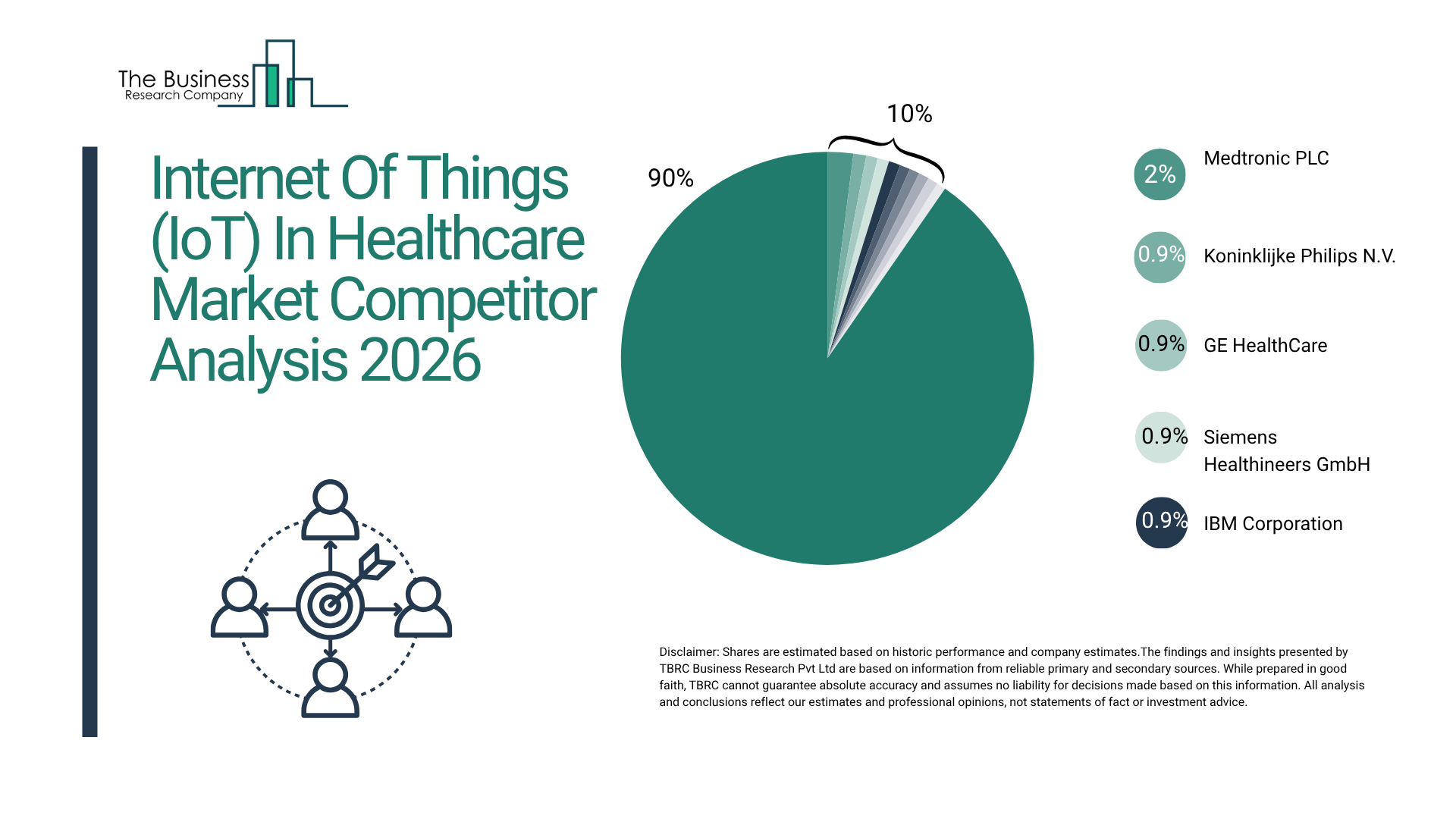
The IoT in healthcare sector remains fairly fragmented, with the top 10 companies accounting for just 10% of total revenue in 2025. Market entry is moderated by factors such as strict healthcare data privacy regulations, interoperability challenges, cybersecurity requirements, and medical device compliance standards. Leading players maintain their market positions through diverse product portfolios, strong healthcare collaborations, global technology networks, and continuous innovation in connected devices and digital health solutions. As demand for remote patient monitoring, connected healthcare systems, real-time analytics, and interoperable infrastructure grows, these companies are expected to invest further in partnerships, product development, and geographic expansion.
Market Shares of Leading Internet of Things in Healthcare Companies
The top companies by market share in 2025 include Medtronic PLC with 2%, Koninklijke Philips N.V., GE HealthCare, Siemens Healthineers GmbH, IBM Corporation, Cisco Systems Inc., Intel Corporation, Microsoft Corporation, SAP SE, and HCL Technologies each holding about 1%. These firms focus on advancing connected medical device technologies, expanding IoT platforms for enhanced connectivity and operational efficiency, broadening remote patient monitoring services, and incorporating AI-driven analytics to deliver predictive and personalized healthcare.
Medtronic’s Prominent Role in the IoT Healthcare Market
Medtronic plc has emerged as a leader worldwide, holding a 2% share of global sales in 2025. Its medical technology and digital health division specializes in connected medical devices, remote patient monitoring solutions, wearable health technologies, and digital platforms tailored for hospitals, care providers, and home-based patient management.
Key Companies Shaping the Internet of Things in Healthcare
The IoT healthcare market includes significant players such as Medtronic PLC, Koninklijke Philips N.V., GE HealthCare, Siemens Healthineers GmbH, IBM Corporation, Cisco Systems Inc., Intel Corporation, Microsoft Corporation, SAP SE, HCL Technologies, Lenovo Healthcare Information Technology, Hill-Rom Services Inc., Senseonics Holdings Inc., Bioserenity, Renalytix AI, Dacadoo, Healthbank, BenevolentAI, Cambridge Cognition, Diagnocat, Myriota, and Aeron Systems.
Supply Chain and Distribution Network in the IoT Healthcare Market
Leading suppliers of raw materials and components for the IoT healthcare market comprise companies like Intel Corporation, Qualcomm Incorporated, NXP Semiconductors N.V., STMicroelectronics N.V., Texas Instruments Incorporated, Analog Devices, Inc., Infineon Technologies AG, Microchip Technology Incorporated, Renesas Electronics Corporation, Murata Manufacturing Co., Ltd., TE Connectivity Ltd., Amphenol Corporation, Sony Semiconductor Solutions Corporation, Skyworks Solutions, Inc., Broadcom Inc., MediaTek Inc., Nordic Semiconductor ASA, Semtech Corporation, Silicon Laboratories Inc., ROHM Co., Ltd., Vishay Intertechnology, Inc., Littelfuse, Inc., TDK Corporation, Epson Device Corporation, and Qorvo, Inc.
Major wholesalers and distributors in the market include McKesson Corporation, Cardinal Health, Inc., Cencora, Inc., Owens & Minor, Inc., Henry Schein, Inc., Medline Industries, LP, Fisher Scientific International LLC, VWR International LLC, Avantor, Inc., Concordance Healthcare Solutions, LLC, NDC, Inc., Bound Tree Medical, LLC, US Med-Equip, Inc., LifeHealthcare Group Limited, DKSH Holding Ltd., Uniphar Group plc, Phoenix Pharma SE, Mediq B.V., Bunzl plc, Movianto International B.V., H.D. Smith, LLC, Alloga Holdings Limited, IMCO, Inc., Hospital Services Limited, and Medisca Inc.
Main End Users of IoT Solutions in Healthcare
The primary end users of IoT healthcare technologies include leading healthcare providers such as HCA Healthcare Inc., Mayo Clinic, Cleveland Clinic, Kaiser Permanente, Ascension Health, CommonSpirit Health, Universal Health Services Inc., Apollo Hospitals Enterprise Limited, Ramsay Health Care Limited, Tenet Healthcare Corporation, Fresenius Medical Care AG, DaVita Inc., NHS Foundation Trusts, Providence Health & Services, Trinity Health, Intermountain Health, Mount Sinai Health System, Sutter Health, Johns Hopkins Medicine, Mass General Brigham, AdventHealth, Cedars-Sinai Medical Center, NewYork-Presbyterian Hospital, Stanford Health Care, and Banner Health.
Our 2026 market reports now feature expanded strategic intelligence through market attractiveness scoring and analysis, total addressable market (TAM) analysis, company scoring matrix graphics and tables, Excel-based dashboards, market hotspots infographics, key technology and future trend analysis, along with updated graphics and tables.
Learn More About The Business Research Company
The Business Research Company (www.thebusinessresearchcompany.com) is a leading market intelligence firm renowned for its expertise in company, market, and consumer research. We have published over 30,000+ reports across 27 industries and 60+ geographies. Our research is powered by 1,500,000 datasets, extensive secondary research, and exclusive insights from interviews with industry leaders.
We provide continuous and custom research services, offering a range of specialized packages tailored to your needs, including Market Entry Research Package, Competitor Tracking Package, Supplier & Distributor Package and much more.
Disclaimer: Please note that the findings, conclusions and recommendations that TBRC Business Research Pvt Ltd delivers are based on information gathered in good faith from both primary and secondary sources, whose accuracy we are not always in a position to guarantee. As such TBRC Business Research Pvt Ltd can accept no liability whatever for actions taken based on any information that may subsequently prove to be incorrect. Analysis and findings included in TBRC reports and presentations are our estimates, opinions and are not intended as statements of fact or investment guidance.
Contact Us:
The Business Research Company
Americas +1 310-496-7795
Europe +44 7882 955267
Asia & Others +44 7882 955267 & +91 8897263534
Email: marketing@tbrc.info
Follow Us On:
LinkedIn: https://in.linkedin.com/company/the-business-research-company“
Oliver Guirdham
The Business Research Company
+44 7882 955267
info@tbrc.info
Visit us on social media:
LinkedIn
Facebook
X
Legal Disclaimer:
EIN Presswire provides this news content “as is” without warranty of any kind. We do not accept any responsibility or liability
for the accuracy, content, images, videos, licenses, completeness, legality, or reliability of the information contained in this
article. If you have any complaints or copyright issues related to this article, kindly contact the author above.

Media gallery