
Multiplex Assays for Drug�Discovery Pharmacodynamic Assessment
Overcoming traditional testing bottlenecks to streamline compound screening and sequential biomarker monitoring for
Press Release Disclaimer: This is a press release distributed through the XPR Media network. It has not been independently verified by our newsroom.

Overcoming traditional testing bottlenecks to streamline compound screening and sequential biomarker monitoring for pharmaceutical R&D
HUSTON, TX, UNITED STATES, November 27, 2026 /EINPresswire.com/ — Robust, high-performance bioanalytical tools are essential to advance modern drug discovery. Every stage, from early-stage candidate screening and process optimization through pre-clinical pharmacodynamic assessment and clinical biomarker monitoring, relies on accurate and efficient measurement. Conventional testing workflows frequently suffer from separate detection of large and small molecules, excessive consumption of precious limited-volume samples, and inconsistent multi-parameter data. This press release introduces Cloud-Clone bead-based multiplex assay kits, which address these practical challenges and deliver an integrated analytical solution for pharmaceutical research.
New-drug innovation is a primary driving force for the biopharmaceutical industry. Measurement accuracy and testing efficiency directly shape research timelines and output quality. For pharmaceutical companies, biotech organizations, pharmacology-focused CROs and academic research groups, traditional single-analyte testing creates well-documented bottlenecks. These include separate workflows for large-molecule and small-molecule analytes, repeated testing that depletes scarce samples, and data variability across multiple assay runs.
Cloud-Clone bead-based multiplex assay kits build upon in-house antibody engineering and recombinant-protein production capabilities. The platform addresses two key industry challenges: simultaneous profiling of large- and small-molecule components within drug extracts, and time-series pharmacodynamic monitoring using limited post-dosing sample volumes. It delivers high-sensitivity, high-throughput and broadly-compatible performance as a cost-effective analytical alternative for drug-discovery programs.
Bottlenecks Within Conventional Testing Workflows
Single-target independent testing has long been standard practice in pharmaceutical laboratories. While suitable for simple measurement tasks, it exhibits notable limitations in complex drug-research scenarios, mainly in compound profiling and in-vivo pharmacodynamic monitoring.
Compound profiling: separate large- / small-molecule detection causes low efficiency and measurement bias
Crude extracts from natural products, compound herbal formulations and biological candidates contain both large-molecule entities (proteins, peptides, cytokines) and small-molecule active components (alkaloids, saponins, flavonoids). Conventional platforms cannot measure these two groups within one assay run.
Large-molecule targets are commonly quantified via sandwich ELISA; small-molecule analytes require competitive ELISA or chromatographic instruments. Samples must be divided and processed separately. Repeated freeze-thaw cycles risk degradation of bioactive substances and introduce experimental artefacts. Independent workflows demand repeated reagent preparation, incubation and readout steps, extending timelines and raising labor and reagent expenses. Workload rises sharply during multi-analyte screening and hinders early-phase candidate triage and process optimization.
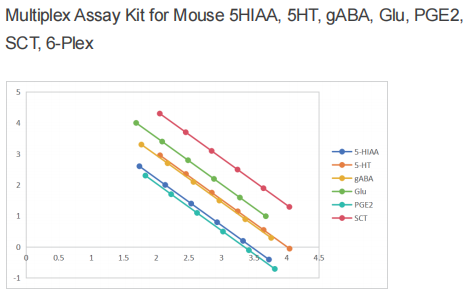
Figure 1. Standard curves of multiplex assay for mouse 5-HIAA, 5-HT, GABA, Glu, PGE2, SCT (6-Plex).
Figure 2. Standard curves of multiplex assay for rat IFNγ, IL-10, IL-18, IL-1α, IL-1β, IL-21, IL-6, TNFα (8-Plex).
Dynamic pharmacodynamic monitoring: scarce-sample constraints compromise data completeness
Pre-clinical animal studies and human clinical trials require sequential biomarker sampling at defined time-points (for example Day 1, Day 7, Day 10 post-dosing) to track shifts in inflammatory mediators, immune markers and functional proteins. These datasets support evaluation of drug onset, duration of action and underlying mechanisms.
Clinical finger-prick samples yield very small volumes; maximum bleed volumes from pre-clinical laboratory animals are also restricted. Traditional single-plex ELISA consumes relatively large sample input. Measuring dozens of pharmacodynamic markers can exhaust limited specimens and result in incomplete datasets. Separate plates and batch processing further introduce inter-plate and inter-batch variation. Poor comparability across time-point measurements weakens the scientific robustness of pharmacodynamic interpretation.
Core Technical Advance: Integrated Combined Large- and Small-Molecule Detection
To resolve compound-screening limitations for drug-extract matrices, Cloud-Clone multiplex assays integrate sandwich-immunoassay and competitive-assay chemistries within a single well. Large-molecule and small-molecule analytes can be measured simultaneously from identical sample material, removing barriers imposed by segregated conventional workflows and streamlining early-phase drug-screening pipelines.
1.Integrated assay architecture compatible with complex drug matrices Leveraging bead-based suspension technology, the optimized system supports two distinct immunoassay principles in one reaction compartment. Sandwich-type detection ensures specificity and sensitivity for large protein targets; adapted competitive-assay chemistry enables reliable measurement of small-molecule substances, which lack dual binding epitopes. The two modes operate without mutual interference and perform robustly with crude natural-product extracts and complex compound-formulation matrices.
2.Cost- and time-efficiency to accelerate process iteration Unlike split-protocol workflows, the integrated multiplex approach requires only one sample loading, one incubation step and one read-out. Multiple large- and small-molecule concentrations are acquired in a single run. Sample consumption and freeze-thaw-related bias are minimized, experimental timelines are shortened, and expenditures for labor, reagents and instrumentation are reduced.
Researchers can readily compare component profiles across different extraction conditions, formulation ratios or production batches. Assay output supports assessment of process stability and formulation suitability, accelerates candidate compound selection and improves iteration speed for early-stage drug development.
Application Enablement: High-Throughput Measurement With Minimal Sample Input Improves Dynamic Pharmacodynamic Profiling
For in-vivo pharmacology and clinical-trial biomarker monitoring, Cloud-Clone multiplex assays deliver low-volume input requirements, high-throughput capacity and consistent data quality, matching the demands of time-series studies using scarce specimens.
1.Maximizing information obtained from limited-volume samples Traditional single-plex assays consume substantial sample material, frequently preventing full-panel biomarker measurement from finger-prick blood or small-volume animal serum. Cloud-Clone multiplex kits enable quantification of dozens of pharmacodynamic markers from one single-well aliquot. This capability unlocks the full analytical value of rare pre-clinical and clinical samples.
2.Batch-unified measurement improves comparability of time-series datasets Samples collected across multiple post-administration time-points may be measured within one unified assay run. Inter-plate and inter-batch systematic deviations associated with separate testing are mitigated. Time-dependent increases and decreases of biomarkers can be reliably mapped, generating accurate time-effect profiles for drug onset, persistence and metabolic turnover. This supports comprehensive evaluation of drug potency, timing of action and molecular mechanisms.
Key Product Attributes for Demanding Pharmaceutical R&D
Drug-discovery programmes place stringent requirements on assay sensitivity, repeatability and stability. Drawing on nearly twenty-years of experience in biological-reagent development and internally managed recombinant-protein and antibody libraries, Cloud-Clone conducts end-to-end quality control spanning target validation, system optimization and finished-kit manufacturing to satisfy pharmaceutical-grade expectations.
1.High sensitivity and broad dynamic range to reduce assay-related bias Assay sensitivity exceeds conventional ELISA performance by 10- to 100-fold, enabling detection of subtle shifts in low-abundance pharmacodynamic biomarkers. An extended linear dynamic range (1 000- to 10 000-fold) reduces necessary sample dilution steps and minimizes errors introduced by dilution workflows.
2.Minimal cross-reactivity for consistent, dependable data Rigorous antibody-pair screening and cross-reaction validation are completed during product development to limit crosstalk between different analytes within one reaction well. Each marker delivers independent, reproducible measurement output suitable for drug-discovery research, project documentation and scientific publication.
3.Broad instrument compatibility lowers adoption barriers Assays are compatible with Luminex platforms and mainstream flow-cytometry-based detection instruments. Pharmaceutical and research laboratories can implement the workflow using existing capital equipment. Both off-the-shelf pre-configured panels and custom-built multiplex panels are supported. Ready-made sets cover common pharmacodynamic, inflammatory and immune markers, while custom panel construction addresses specialized mechanistic-study requirements for diverse drug-discovery projects.
Industry-Wide Impact: Technical Innovation Promotes Advancement in Pharmaceutical R&D
Global drug-discovery programmes pursue higher efficiency, improved precision and controlled costs. Cloud-Clone multiplex bead-based assays cover key phases from early compound profiling through later-stage pharmacodynamic biomarker monitoring. Beyond sample-volume savings, faster workflows and cost reduction, the technology supports a conceptual shift: evaluation evolves from limited single-marker observations toward multi-dimensional, time-resolved comprehensive pharmacodynamic profiling.
Researchers gain deeper mechanistic insights, capture subtle pharmacodynamic signals and obtain solid datasets guiding extraction-process refinement, formulation improvement and clinical-trial design.
Cloud-Clone will continue advancing multiplex-assay technology and refining pharmaceutical-oriented assay solutions. Reliable, stable and adaptable multiplex products will serve pharmaceutical enterprises, CRO organizations and research teams, supporting translation of promising candidate molecules from laboratory investigations toward clinical application and fostering high-quality innovation across the biopharmaceutical sector.
Sample scarcity, separate large- / small-molecule measurement and inter-batch data inconsistency have long created practical hurdles for drug-discovery teams. Cloud-Clone integrated multiplex bead-based assays provide a feasible path to resolve these pain-points. By enabling simultaneous large- and small-molecule profiling and high-throughput biomarker detection with minimal sample input, the platform strengthens compound screening and dynamic pharmacodynamic assessment. Cloud-Clone will keep optimizing multiplex-assay resources to empower global pharmaceutical research communities.
SuKi Duan
CLOUD-CLONE CORP.WUHAN
Visit us on social media:
LinkedIn
Instagram
TikTok
X
Legal Disclaimer:
EIN Presswire provides this news content “as is” without warranty of any kind. We do not accept any responsibility or liability
for the accuracy, content, images, videos, licenses, completeness, legality, or reliability of the information contained in this
article. If you have any complaints or copyright issues related to this article, kindly contact the author above.

Media gallery
