AnswerThis Releases Research Gap Finder With Evidence and Linked Sources
AnswerThis identifies potential research gaps using scholarly abstracts, supporting evidence, follow-up questions, and
Press Release Disclaimer: This is a press release distributed through the XPR Media network. It has not been independently verified by our newsroom.
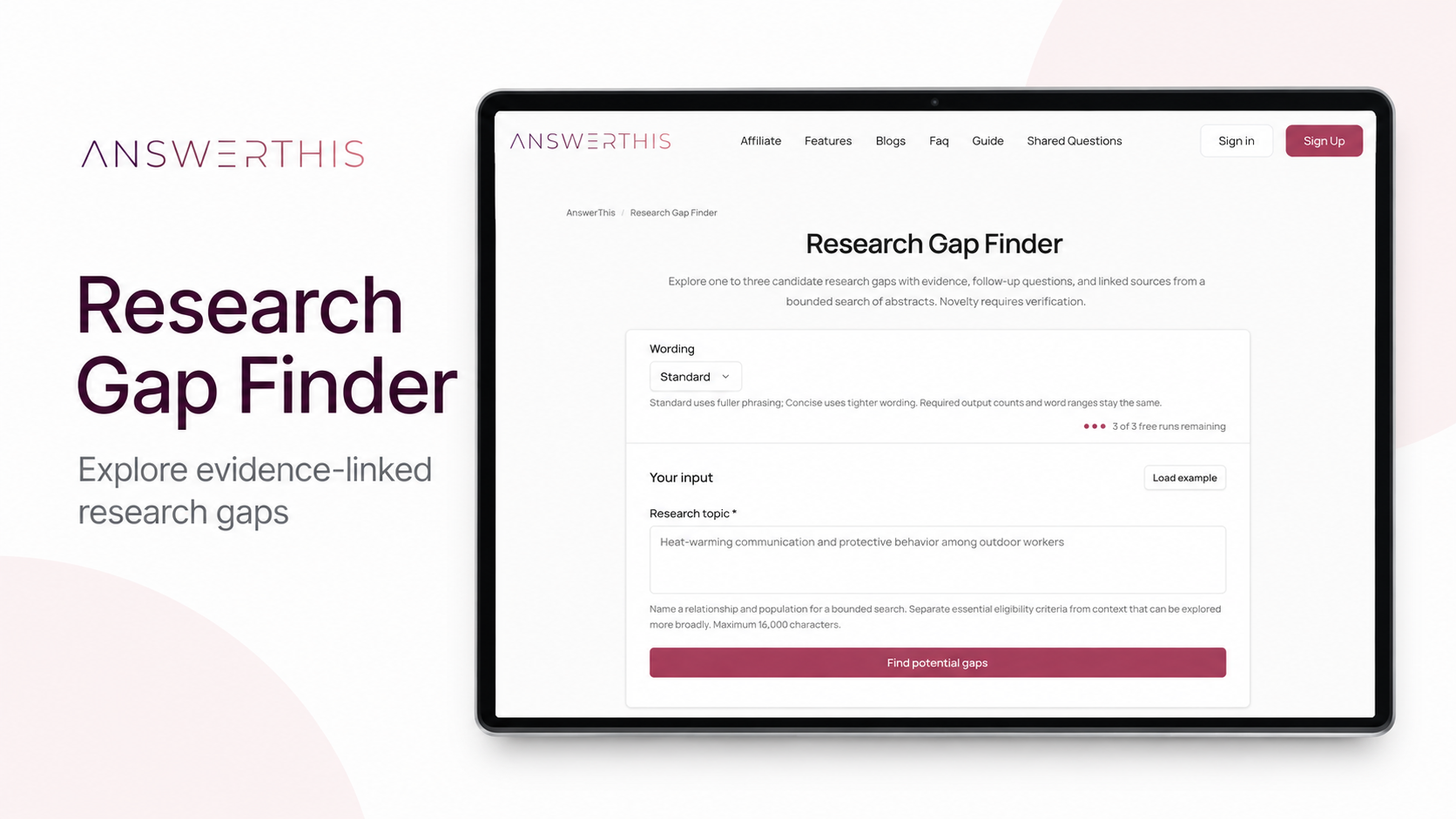

AnswerThis identifies potential research gaps using scholarly abstracts, supporting evidence, follow-up questions, and source links.
SAN FRANCISCO, CA, UNITED STATES, November 24, 2026 /EINPresswire.com/ — AnswerThis, the AI research assistant backed by Y Combinator, has released a Research Gap Finder that returns candidate research gaps with evidence and linked sources. Researchers describe a topic and receive one to three candidates, each with evidence from retrieved abstracts, follow-up questions, the search scope used and links to scholarly records. Every suggestion requires verification, and three successful runs are free per browser.
The distinction between a candidate and an established gap addresses a central research problem: an apparently unanswered question may already have an answer outside the material searched. A 2011 AHRQ framework by Robinson, Saldanha and McKoy defines a research gap as “a topic or area for which missing or inadequate information limits the ability of reviewers to reach a conclusion for a given question.” Checking that uncertainty requires examining what studies actually establish. The National Science Board’s The State of U.S. Science and Engineering 2026 reported worldwide output of 3.5 million science and engineering articles in 2024, illustrating the volume of literature researchers must navigate.
To make that check possible, the AnswerThis Research Gap Finder with evidence and linked sources separates its suggestions from the evidence used to draft them. AnswerThis search retrieves scholarly records and available abstracts, and OpenAI drafts the candidate gaps. The tool does not read full papers. A suggestion therefore concerns something “not addressed in the abstracts analyzed here,” not something proven absent from the field.
Researchers can focus the search with a topic of up to 16,000 characters, ideally naming a relationship and a population. Standard or Concise wording options control presentation, while the result displays evidence, follow-up questions, source links and search scope. Copying and text downloads preserve the source links. Failed requests do not count toward the three successful free runs per browser, and signing up does not add runs on that page.
Those links establish traceability, not the correctness of every interpretation. Researchers should compare each suggestion with the cited abstracts, read relevant full texts and search more broadly before claiming novelty. The latest input and result remain in the tab’s session storage, so users should copy or download results before leaving. The page also instructs users not to enter confidential information.
The need to distinguish an appealing idea from a defensible project is reflected in research on AI-generated ideas. Si, Yang and Hashimoto’s study presented at ICLR 2025, involving ideas from 49 experts and reviews by 79, found that AI-generated ideas received higher novelty ratings but slightly weaker feasibility ratings than expert ideas. Their ICLR 2026 follow-up found that the advantage reversed on many measures after the ideas were carried out. These findings concern research ideas, not AnswerThis’s accuracy or proof that AI identifies research gaps better than people.
Questions about finding research gaps
How do I find a research gap?
Start with recent systematic reviews and their future research sections, then compare established findings with a precise unresolved question. Look for missing populations, outcomes, settings or methods and for conflicting results. Test the apparent gap through broader searches and full-text reading before building a study on it.
What is a research gap?
A research gap is a question that existing evidence does not answer adequately enough to support a conclusion. The AHRQ framework identifies insufficient or imprecise information, biased information, inconsistency or unknown consistency, and information that does not fit the question as reasons gaps arise. A category label alone does not establish that a gap exists or merits a study.
Can AI find research gaps?
AI can suggest candidates, but a suggestion is not proof of novelty. AnswerThis shows the abstract evidence, search scope and linked records behind its suggestions so researchers can challenge them. Full-text checking and broader searches remain necessary.
For that verification process, the AnswerThis guide to identifying a research gap explains five methods, including reading systematic reviews, mapping study coverage and investigating conflicting findings. A separate guide covers the seven types of research gaps, with examples. These categories organize possible uncertainties rather than establish a universal taxonomy. Researchers can use the guides alongside the tool to test, revise or reject a candidate before developing a research question.
About AnswerThis
AnswerThis (answerthis.io) is an AI research assistant for literature reviews and evidence synthesis. It searches more than 250 million academic papers, drafts reviews with citations that can be checked against their sources, and offers free research tools including a PRISMA 2020 flow diagram generator, a citation generator for 24 styles and a reference checker. AnswerThis is backed by Y Combinator and is used by more than 1 million researchers.
Ryan Mccarroll
AnswerThis.io
ryan@answerthis.io
Visit us on social media:
LinkedIn
Instagram
Facebook
YouTube
TikTok
X
AnswerThis Tutorial for Beginners: Get Started in 2 Minutes
Legal Disclaimer:
EIN Presswire provides this news content “as is” without warranty of any kind. We do not accept any responsibility or liability
for the accuracy, content, images, videos, licenses, completeness, legality, or reliability of the information contained in this
article. If you have any complaints or copyright issues related to this article, kindly contact the author above.

Media gallery